
3D rendering and lighting in Nucleon Engine
Nucleon Engine renders 3D games with a physically based, GPU-driven renderer written in-house. One render interface runs on Direct3D 12, Vulkan and OpenGL, shaders are written once in HLSL, and the same material, lighting and shadow systems serve a small level and a large streamed world.
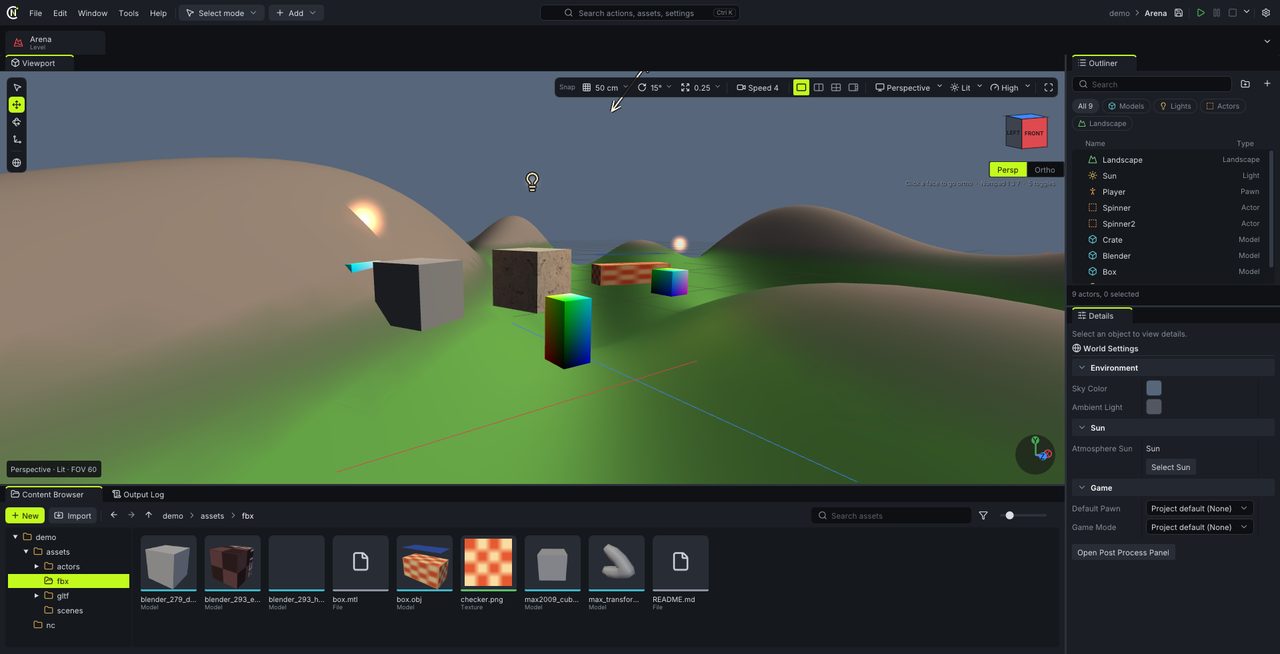
One render interface, three graphics APIs
The renderer talks to the GPU through a single interface (the RHI). Direct3D 12 is the first-class backend on Windows; Vulkan and OpenGL are real backends of the same interface. Shaders are written once in HLSL and compiled for each API. Pipelines are cached on disk and a pipeline database is cooked with the game and preloaded at first launch, so the engine is built to avoid shader-compile hitches during play. A render graph declares passes and resources, inserts barriers, culls passes nobody reads and shares transient memory.
Physically based materials and a material graph
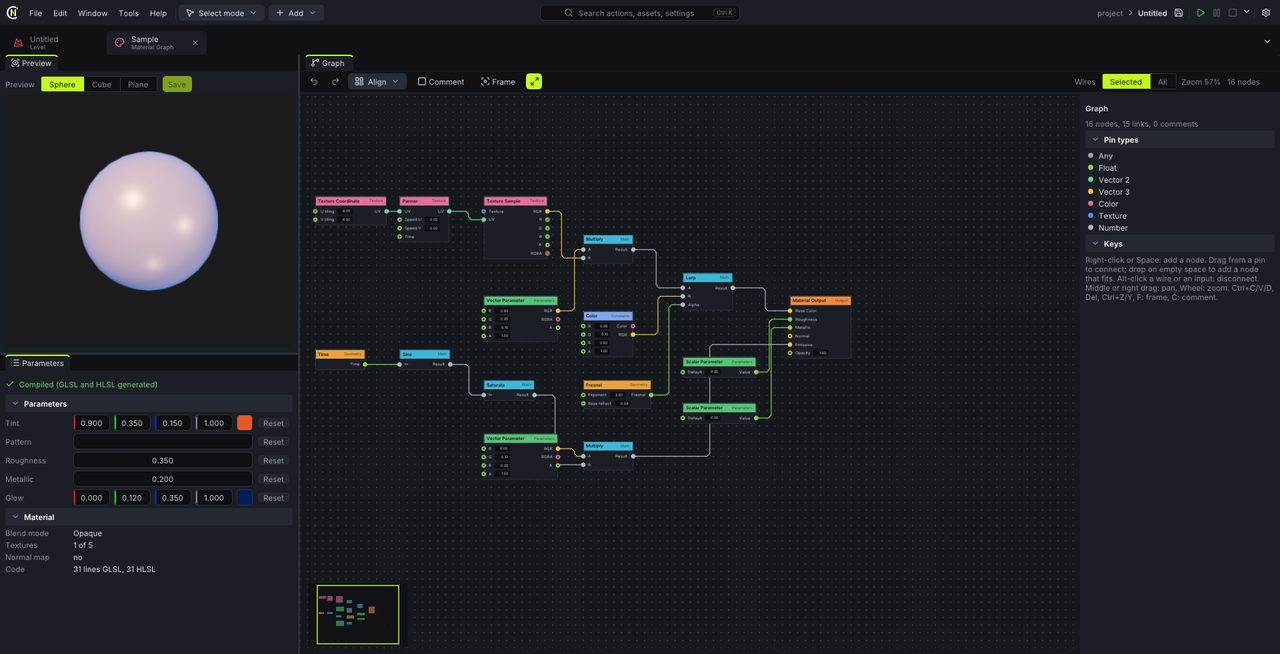
Materials are physically based. Build one from nodes in the material graph editor and see it live on the model. Graph materials compile to shaders for every backend. Material assets are plain text files (.ncmat, .ncmatgraph).
Lights and shadows
- Clustered lights: point, spot, directional, sky and area lights, with IES profiles for real-world light shapes.
- Shadows: cascaded shadow maps for the sun, virtual shadow maps, far shadow tiles that are cached, and contact shadows.
- Reflections: screen-space reflections, box and sphere reflection captures (baked or live), and reflections from the global illumination system.
Global illumination without ray-tracing hardware
Indirect light is computed on the GPU with compute shaders: probe volumes, screen-space traces, mesh distance fields, a surface cache and a radiance cache. Because it does not need ray-tracing cores, it runs on ordinary GPUs. For large worlds, baked probe volumes and per-cell light volumes stream in with the world cells.
Virtualized geometry
Heavy static meshes are cut into clusters. The GPU picks the level of detail for each cluster, so a dense mesh costs what is visible. Qualifying static models use virtualized geometry by default and are cooked once into a cache; skinned meshes, translucent materials and very small meshes use the classic path automatically. Static models also live in a GPU-driven retained scene with instancing and hierarchical-Z occlusion culling.
Culling and level of detail
Hierarchical-Z occlusion, authored occluders and rooms with portals, software occlusion culling, precomputed visibility baked in the editor, mesh LODs, HLOD for far content and impostors for distant plants.
The natural world
A physically based sky and atmosphere with aerial perspective, volumetric fog and clouds, and a night sky with real star positions. Day-night cycle and weather, with rain, lightning and wet surfaces. Rivers and an ocean with refraction and depth absorption. Instanced foliage and grass with level of detail, impostors and hierarchical wind.
Post-processing and effects
Bloom, depth of field, motion blur, temporal anti-aliasing, tone mapping, auto-exposure and colour grading, decals, and a particle and effects system with an FX graph.
Quality presets and upscaling
Five presets (Low, Medium, High, Epic and Cinematic) set eight groups of options, and every group can be set on its own. Presets change settings, not resolution. Temporal upscaling uses the engine’s own TAA, AMD FSR 3 on Direct3D 12 and Vulkan, and NVIDIA DLSS on supported RTX GPUs, with dynamic resolution to hold a target frame rate. The player gets an options menu and a Lua Graphics API.
Textures
Compressed textures (BC1, BC3, BC5, BC7 and ASTC), mip streaming that loads finer levels only for what the camera needs, and a derived-data cache so import work is done once.
Cinematic output
Sequencer sequences render offline and deterministically to image files, including EXR, with the Movie Render Queue.