
Open-world game engine: streaming, landscapes and HLOD
Nucleon Engine is built for large worlds. A level is cut into cells that load and unload by distance, loading runs on worker threads with priorities, distant cells are replaced by HLOD proxies, and the landscape tools let you sculpt, paint and plant the ground. Nucleon’s own test world is a 4 km by 4 km streamed map.
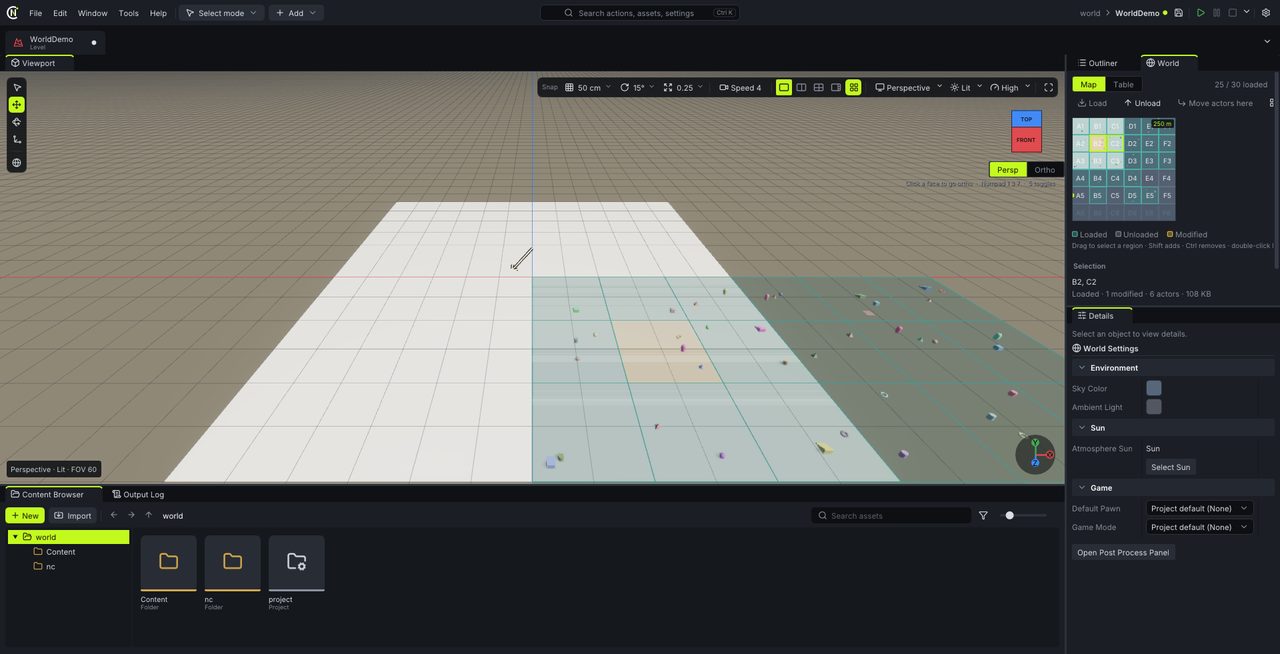
World partition: a level in cells
A partitioned level is a grid of cells. The runtime loads the cells near the streaming sources (the camera by default) and unloads the ones that are far, with hysteresis so cells do not flicker at the border. You can add grids with their own radius and ranges by object type. The World panel shows the cells and builds HLOD. Cells can be packed into compact files and prefetched, and the entities of a cell are created in small time slices so a cell arriving does not stall a frame.
Streaming that does not stall the frame
- Asynchronous loading: a pool of worker threads reads and decodes models, textures and cells, ordered by priority and age.
- I/O scheduler: admission control, chunked reads, and readers tuned to the kind of disk. On Windows, DirectStorage can be used for reads.
- Priority by distance and velocity: the runtime looks ahead along the direction you move.
- Texture streaming: textures keep their small mips resident and load finer levels only for what the camera sees.
- Frame pacing: pipelines are precached so streaming new content does not trigger shader compilation in the frame.
HLOD and far terrain
HLOD replaces groups of far objects with one cheap proxy. The editor has a Build HLOD step, and it also works from the command line. Beyond the streaming radius the landscape continues as a coarse far-terrain file per tile, so the horizon is not empty.
Landscape tools
Sculpt, paint layers, erode, lay splines for roads and rivers, and paint foliage in the Landscape panel (Manage, Sculpt, Paint, Foliage, Erode and Splines tabs). Landscapes are heightfield tiles with several paint layers, and several landscapes can sit side by side with a level of detail and stitching. For caves and tunnels, the terraform volume digs under the heightfield and a tunnel can be made from a mesh at its mouth. Procedural placement of plants and rocks is in testing.
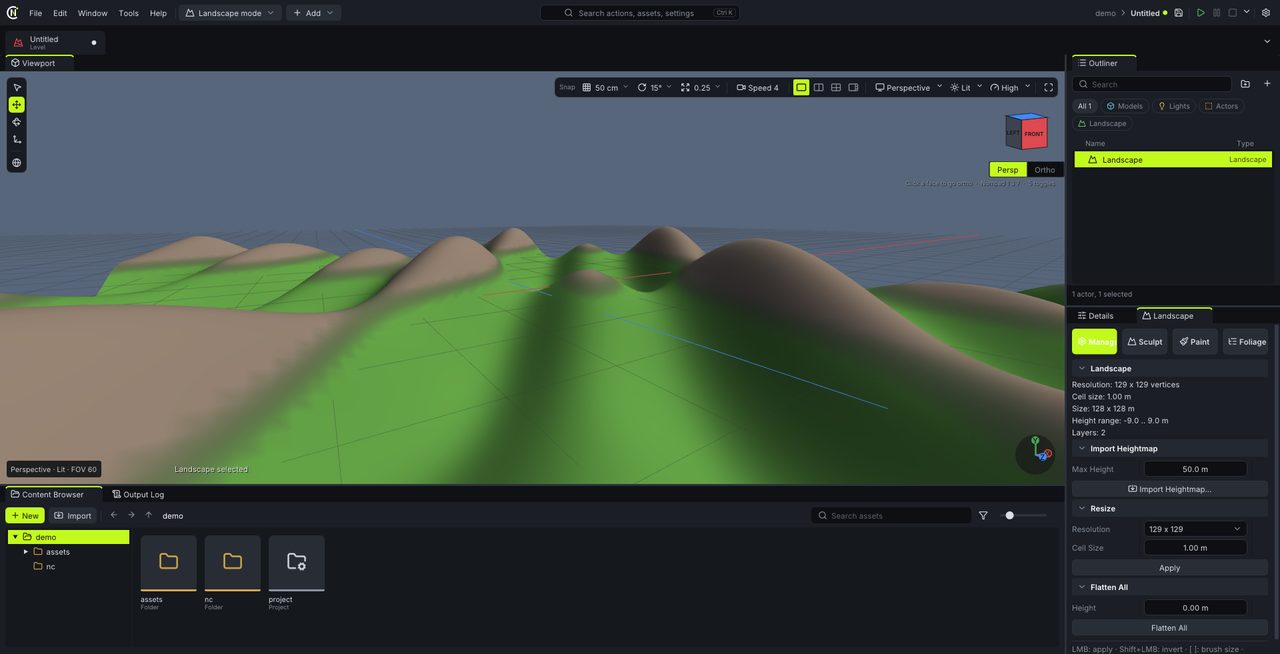
Large coordinates
A moving origin keeps numbers small far from the center of the world, so precision does not fall apart on big maps. The editor shows Z-up metres.
Interiors, data layers and living worlds
Interior instances with rooms and portals stream with their building. Data layers load and unload sets of objects, such as a camp that appears when a quest starts. Mass agents for crowds and traffic are in testing.
Lighting and geometry for large worlds
Large-world lighting uses baked probe volumes and light volumes that stream with the cells. Virtualized geometry and a GPU-driven scene keep the cost of dense content tied to what is visible.
Designed to scale
The streaming, lighting, geometry and vegetation systems are designed to scale to AAA-style open worlds, and work on this goal is under way.